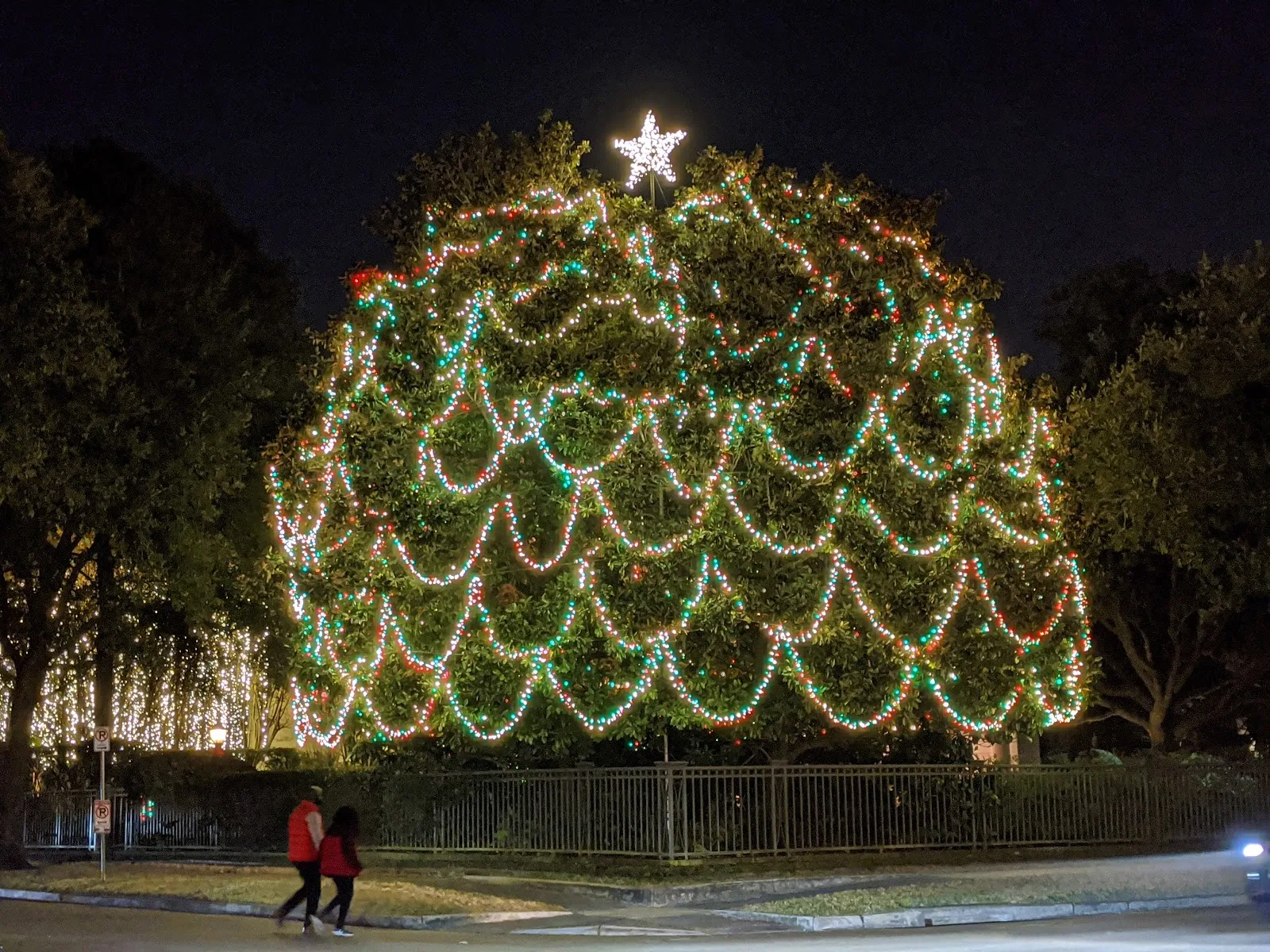
The twenty minutes that make the difference, and the settings worth changing before you leave the house.
The best photographs of River Oaks happen in the twenty minutes after the lights come on and before the sky goes black. In December that is roughly 5:20 p.m. to 5:45 p.m. Almost everyone arrives two hours late.
Just after sunset, while the sky still holds deep blue.
Monday to Wednesday. Weekend traffic makes stopping impossible.
A phone is genuinely fine. Something to brace it against is worth more than a better camera.
Nothing. The neighborhood is free and public.
At 8 p.m. the houses are gone and only the bulbs remain. The photograph becomes colored dots floating on black, which is what most River Oaks pictures online look like.
During blue hour the sky is still bright enough to record the roofline, the oaks and the shape of the house behind the lights. The camera can hold both at once. That is the whole trick, and it costs nothing but arriving earlier.
It is a narrow window. Twenty-five minutes after sunset the advantage is gone, which is why a weeknight matters: on a Saturday you will still be sitting in line on the boulevard when the light has already left.
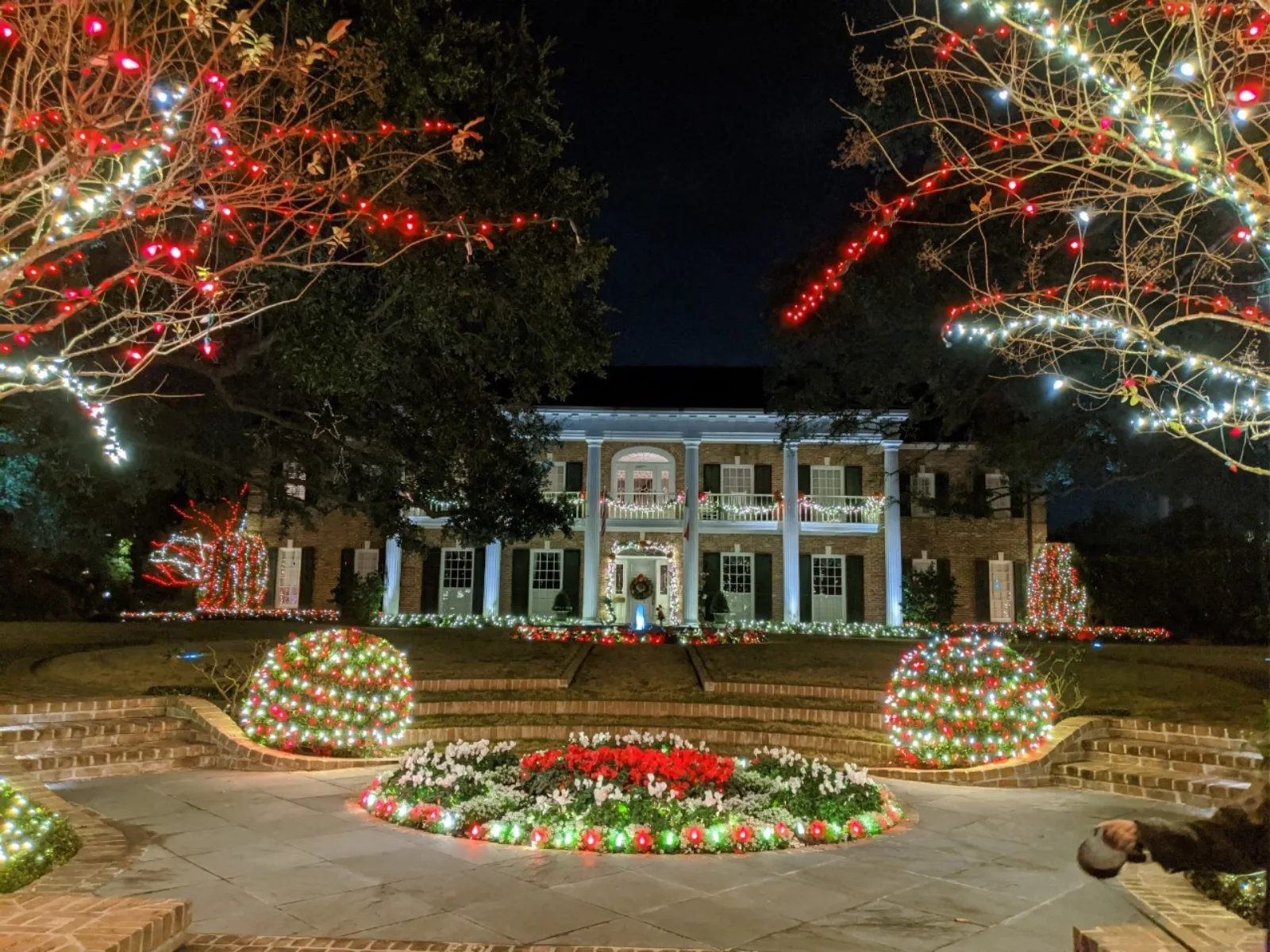
Modern phones handle this well on automatic. These four adjustments are the ones that still make a visible difference.
Flash lights the branch three feet in front of you and does nothing to a house fifty feet away. It is the single most common way these photographs are ruined.
Tap a lit section of the house, then drag the exposure slider down a notch or two. Phones overexpose strings of bulbs into white blobs. Underexposing slightly brings the colors back.
Night mode takes two to three seconds. Brace your elbows against your ribs, or the phone against a fence post or car roof, and let it finish before moving.
Digital zoom at night turns everything to mush. Walk closer instead, or switch to the dedicated telephoto lens if the phone has one.
If the phone offers a RAW or ProRAW option, use it for three or four frames. Christmas lights are exactly the high-contrast situation where recovering a blown-out highlight afterwards is worth the file size.
The displays are built to be seen from the road, which means the obvious position is usually the right one. Three things improve it.
The oaks on River Oaks Boulevard are half the character of the neighborhood. Shooting through lit branches gives the picture depth that a flat house front never has.
Crossing the street buys you the whole house instead of a corner of it, and keeps you off private lawns.
Crouching to waist height makes the house taller and pulls the lit hedges into the foreground. It costs nothing and it is the difference between a snapshot and a photograph.
This is where most people give up, because the camera exposes for the lights and the faces go black, or exposes for the faces and the lights disappear.
The fix is to stop asking the phone to do both. Stand the group where something else is lighting their faces: a street lamp, a lit porch, the glow off a white wall. Then the camera only has to balance two bright things instead of one bright and one dark.
Failing that, use portrait mode with night mode on and have everyone hold completely still for a count of three. It works more often than people expect.
Blue hour helps here too. There is still enough ambient light at 5:30 to put something on a face without a flash, which is not true at eight.
The whole-house photograph is the one everybody takes. These four are usually better, and nobody else on the street is looking for them.
River Oaks wraps full-grown live oaks, not just rooflines. One tree filling the frame reads as Houston in a way a decorated facade could be anywhere.
Stand on the sidewalk and shoot straight along the road so the lit trees recede into the distance. It needs a long lens or a steady hand, and it is the best photograph on the street.
A wreath, a lit hedge, bulbs close enough to go soft behind the subject. Easy, forgiving in low light, and it breaks up a run of identical wide shots.
Two silhouettes walking past a vast lit tree says more than a posed group does, and it sidesteps the lighting problem entirely.
Most of these photographs need three adjustments and nothing else.
This recovers the color in bulbs that blew out to white, which is the usual failure. Do it before anything else.
Enough to bring the roofline and branches back, not so much that the night sky turns grey and muddy.
The lights are already saturated. Pushing it further is what makes a Christmas photograph look fake.
A windshield adds reflections, a side window adds a second layer of glass, and the driver cannot shoot at all.
If you are shooting from a car, wind the window fully down and brace the phone against the frame rather than holding it in open air. Reflections off glass are the thing that quietly ruins half of these pictures.
The open option is the lights route on the bike: no glass anywhere, both hands free, sixteen seats, and the whole group moving at about six miles an hour, which is slow enough to actually frame a shot. It runs every night from November 30 to December 31 at $499 for the bike.
Bring layers and something hot. The packing list is here, the Christmas route is here, and the practical street guide to the neighborhood is here.
These are private homes. The display continues because visitors behave themselves.
Sidewalks and the street are fine. Walking onto grass for a closer angle is not, however good the shot would be.
Flying over private homes at night, over traffic, in a residential neighborhood is a bad idea for several separate reasons.
Stopping in the lane for a photograph backs up the boulevard for everyone behind you. Park properly, or shoot from the sidewalk.
More Houston guides are on the guides page, including the rest of the city's displays for 2026.
Houston Bike Bar operates the 16-seat electric bike described above. Photographs on this page are of Houston holiday displays from previous seasons; individual homes vary from year to year.
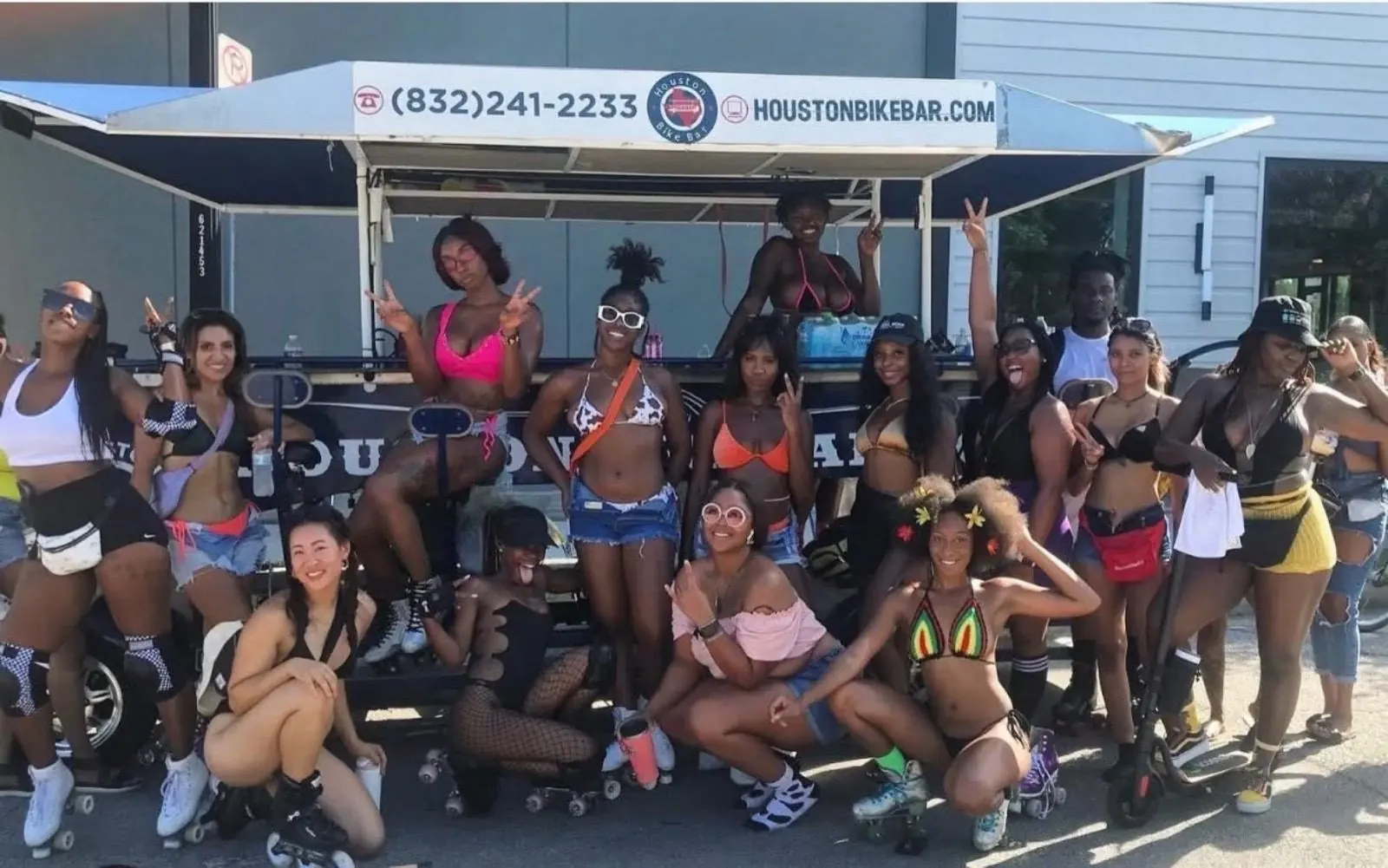
Two hours through the lit streets with both hands free and no windshield in the way. $499 for the whole bike, November 30 to December 31.
 Houston

